
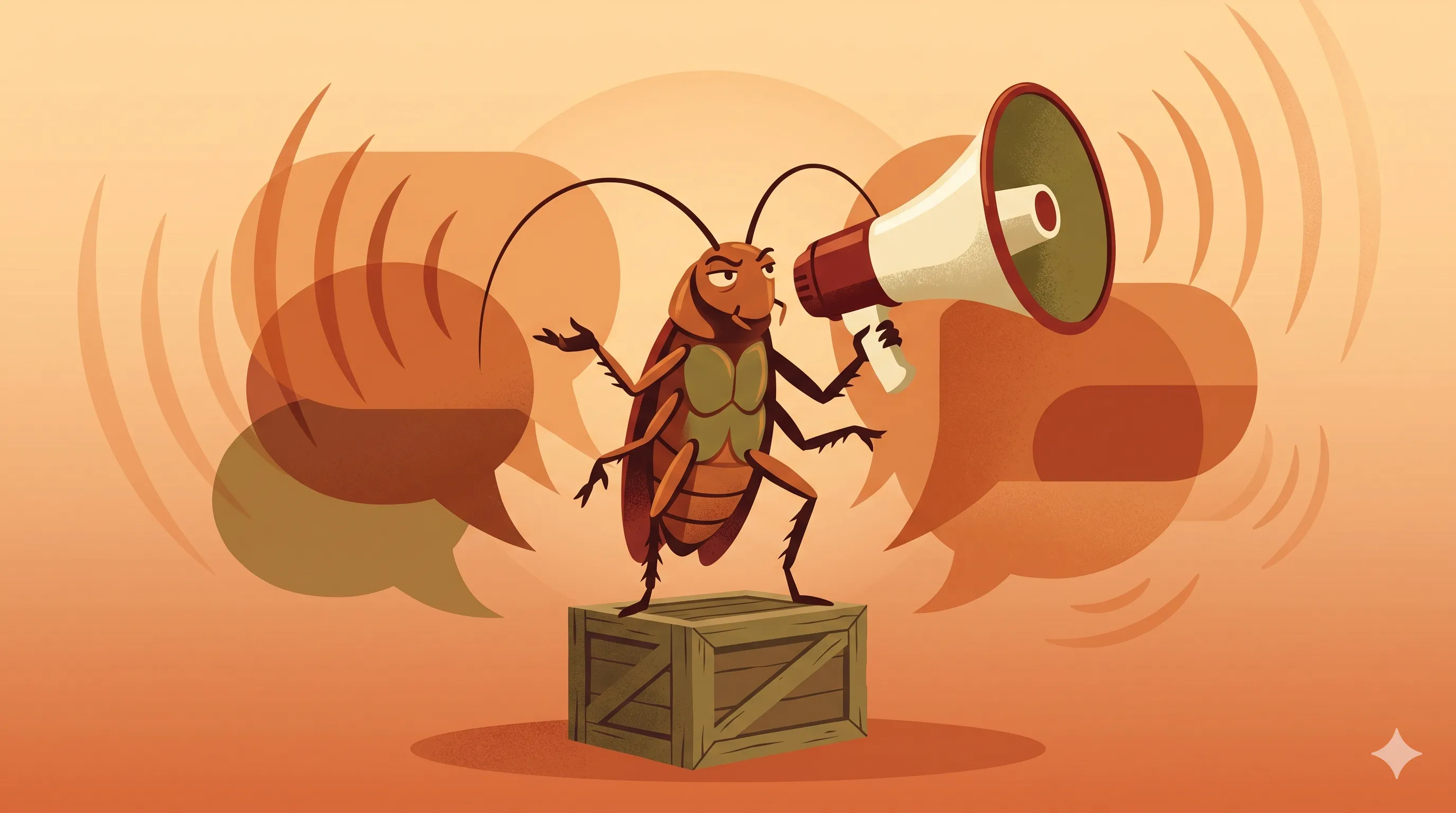
Cockroach Janta Party: How a Meme Became a Youth Protest Brand
How a Supreme Court remark sparked India's biggest political meme movement in 2026 — Cockroach Janta Party, semiotic inversion, and Gen-Z protest.
In May 2026, India watched a satirical political “party” rocket from zero to over 22 million followers in 10 days. By any measure of digital scale, the Cockroach Janta Party (CJP) is one of the fastest-growing political movements in South Asian history.
It is also entirely a meme.
This is the story of how a single off-the-cuff remark in the Supreme Court of India became — in less than two weeks — a national protest brand, complete with manifesto, hashtag, satirical membership criteria, and a brief but very real standoff with the government.
The Spark — 15 May 2026
On 15 May 2026, during a Supreme Court hearing on senior advocate designations and fraudulent professional credentials (Sanjay Dubey v. Registrar General, Delhi HC), Chief Justice of India Surya Kant made an oral remark that would become inadvertently load-bearing:
“There are youngsters like cockroaches, who don’t get any employment or have any place in the profession. Some of them become media, some of them become social media, RTI activists and other activists, and they start attacking everyone.”
The CJI also described such individuals as “parasites” of society.
The remarks went viral within hours. The next day, CJI Kant issued a clarification stating he had been misquoted, and that his comments referred specifically to those practising with fake or bogus degrees — not the youth of the country. By then, the framing had already crystallised online.
Context matters here: India in 2026 has roughly 367 million people in Generation Z, a cohort already strained by graduate unemployment, inflation, and a recent national controversy over leaked NEET-UG medical entrance exam papers. The remark, however it was intended, landed in highly combustible cultural conditions.
The Founder and the Launch
The person who turned online outrage into a structured movement is Abhijeet Dipke — a 30-year-old political communications strategist and postgraduate PR student at Boston University. Dipke previously worked as a strategist for the Aam Aadmi Party (AAP), a background that both his supporters and critics agree gave him a sophisticated understanding of digital political campaigning.
On 16 May 2026, Dipke launched the CJP’s online presence. The name itself is a parody:
- Cockroach — reclaiming the CJI’s insult.
- Janta (Hindi for “people”) — populist framing.
- Party — a direct play on the ruling Bharatiya Janata Party (BJP).
Per his own account, Dipke drafted the satirical manifesto and constitution using generative AI tools — Claude and ChatGPT — and built the visual identity in Canva. That detail is itself a cultural artefact: a 2026 Indian political movement assembled with the same tools its target demographic uses to make Instagram reels.
The tagline: “Voice of the Lazy & Unemployed.”
The Viral Explosion
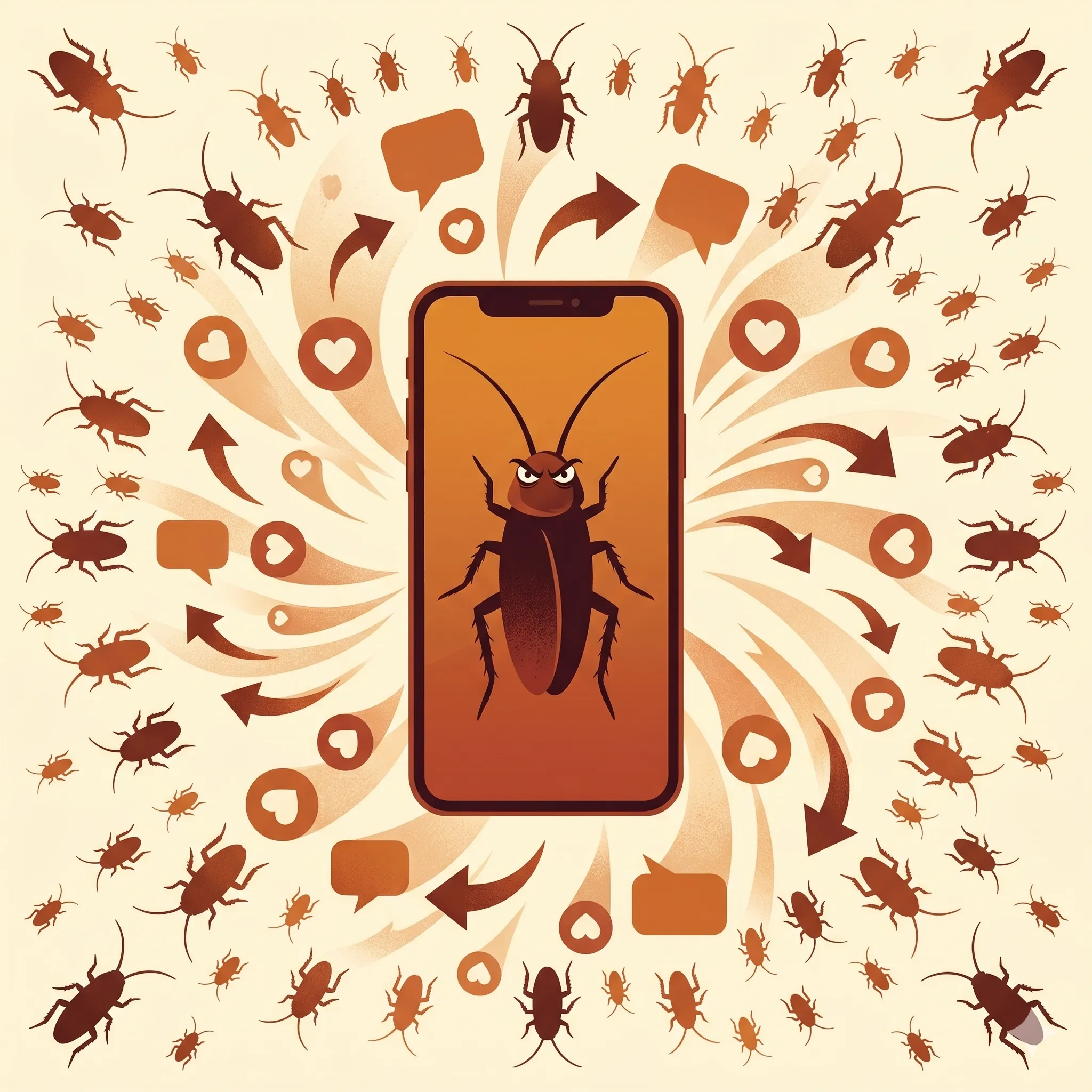
CJP scaled faster than any digital-political campaign in South Asian history.
| Day | Milestone |
|---|---|
| 48 hours | Over 40,000 signups on the official website |
| 78 hours | 3 million Instagram followers |
| <5 days | 10 million followers — surpassing both the BJP and Indian National Congress on Instagram |
| ~6 days | Over 20 million followers |
| Peak | 22.5 million followers (before platform suspensions) |
For comparison, the BJP’s official Instagram account sits around 9.3 million followers — built over years.
The aesthetic was distinct: a stylised, AI-generated cockroach standing on a smartphone screen as logo; deliberately absurdist membership criteria (“unemployed by choice or force,” “lazy,” “chronically online at least 11 hours daily,” “capable of professional ranting”); and the hashtag #MainBhiCockroach — “I too am a cockroach.”
The demographic that responded: Gen-Z, university students, urban youth. The distribution mechanic was Instagram-native — short carousels, reels, satirical text overlays. Memes as the primary format. Not press releases.
The Five-Point Manifesto
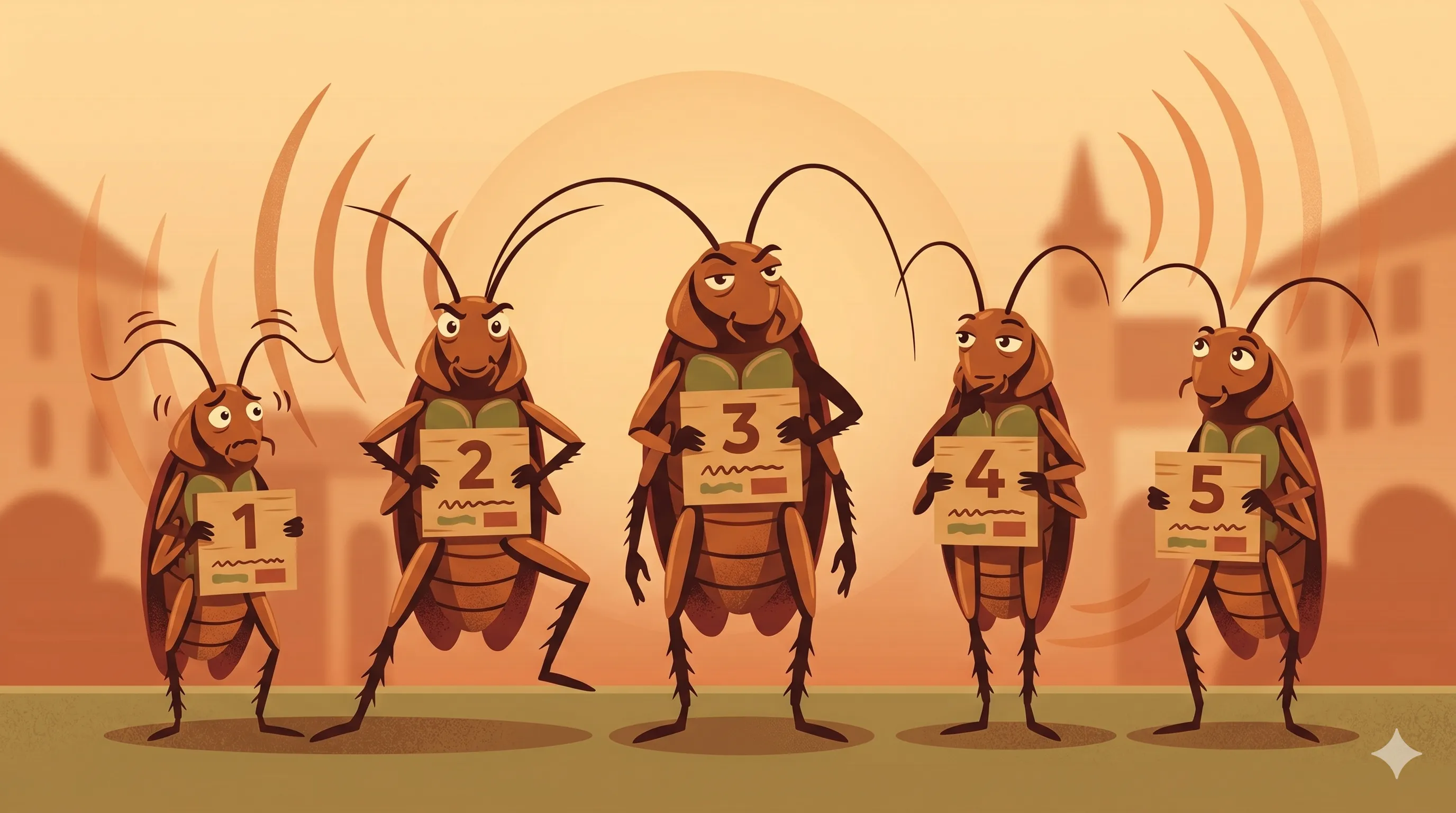
CJP’s manifesto is short and entirely targeted at structural pain points in Indian governance:
- No Rajya Sabha seats for retired CJIs. No post-retirement reward for Chief Justices via appointment to the upper house of Parliament. Aimed at the perceived executive co-optation of the judiciary.
- UAPA for vote-deletion officials. If a Chief Election Commissioner permits the deletion of legitimate votes, they should be arrested under the Unlawful Activities (Prevention) Act — India’s most stringent anti-terror law. The framing: stripping a citizen’s vote is “no less than terrorism.”
- 50% women in Parliament and Cabinet. Up from the current 33% mandate, without expanding the total size of Parliament.
- Cancel broadcast licences of media monopolies. Specifically calling out the Adani Group and Reliance Industries’ media holdings, with financial audits of “Godi media” (a pejorative for pro-establishment news outlets).
- 20-year election ban for defecting MLAs and MPs. Targeting the “horse-trading” of elected representatives between parties.
Following input from RTI activist Anjali Bhardwaj, CJP also committed to operating entirely under the Right to Information Act, rejecting anonymous electoral bonds, and explicitly not establishing a “secret Cockroach CARES Fund” — a satirical jab at the government’s opaque PM CARES fund.
Whether you read the manifesto as serious policy, political satire, or both, it is a structurally coherent document. That is unusual for a movement assembled in a week.
Why the Cockroach?
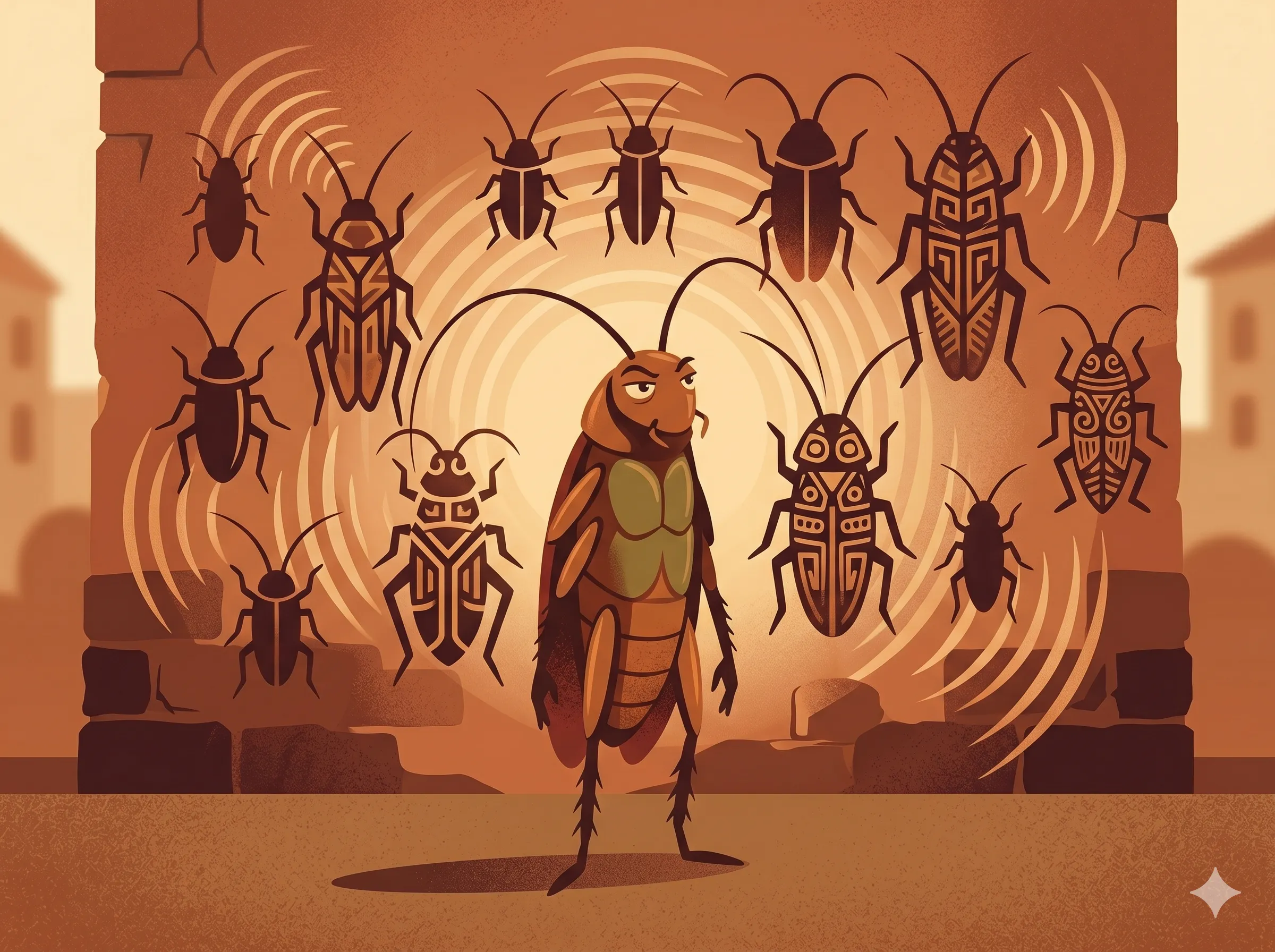
The mechanic at work here has a name in linguistics and political communication: semiotic inversion — reclaiming a derogatory term to neutralise its sting and forge a unifying identity.
Examples are not new:
- The LGBTQ+ community reclaimed “queer.”
- American voters reclaimed “deplorables” in 2016.
- Online communities have done the same with “snowflake,” “boomer,” and countless others.
What makes the cockroach particularly potent as a symbol is biology. Cockroaches predate dinosaurs by 80 million years and have survived multiple mass extinctions. Embracing the cockroach allowed CJP to tie biological durability to political endurance — we survive everything you throw at us.
There is also a quietly Indian precedent. In 1995, former Chief Election Commissioner T.N. Seshan published A Heart Full of Burden, which used the cockroach as a metaphor for the resilience of the Indian citizen surviving systemic corruption. CJP’s framing rhymes with Seshan’s by three decades.
The Government Response
The movement’s velocity attracted state attention quickly:
- 21 May 2026: The Ministry of Electronics and Information Technology (MeitY) ordered X to withhold the CJP’s official account in India, citing Section 69(A) of the Information Technology Act and inputs from the Intelligence Bureau alleging threats to national sovereignty.
- 23 May 2026: CJP’s official website went offline. Dipke alleged government takedown; the party’s Instagram accounts reported being hacked and suspended.
- 24 May 2026: A PIL was filed in the Supreme Court seeking a CBI investigation into CJP for “commercial exploitation” of court observations.
- 25 May 2026: The Supreme Court declined to grant urgent hearing on the PIL. CJI Surya Kant — the original source of the cockroach remark — advised the petitioners: “Don’t take it so sentimentally.”
Meanwhile, Dipke filed a petition in the Delhi High Court challenging the constitutionality of the X account block. The movement continues to operate through backup accounts.
Several established political figures and cultural voices have publicly extended support — Mamata Banerjee and Abhishek Banerjee (Trinamool Congress), filmmaker Anurag Kashyap, comedian Kunal Kamra, and actors Konkona Sen Sharma, Fatima Sana Shaikh, Dia Mirza, and Esha Gupta. Critics — including rapper Santy Sharma — have dismissed CJP as “internet drama” and a manufactured digital campaign, pointing to Dipke’s AAP background as evidence of orchestration rather than spontaneity.
International framing has tended toward “Gen-Z protest movement” — outlets like CNN, Al Jazeera, NBC, France 24, and CBS placing CJP alongside recent youth uprisings in Sri Lanka and Bangladesh. Domestic Indian coverage, especially in The Wire, Scroll, and LawBeat, has drilled deeper into the legal and institutional implications, with some opinion pieces analysing the original “cockroach/parasite” framing through a historical-dehumanisation lens.
What CJP Is — and Isn’t
It is not a legally recognised political party. CJP is not registered with the Election Commission under Section 29A of the Representation of the People Act, 1951. It has no formal office-bearers in the legal sense and no electoral standing.
It is a sophisticated, scale-tested digital protest brand — a piece of meme infrastructure that successfully translated a viral insult into a movement people will join, defend, and continue building under takedown pressure.
Whether that infrastructure outlives its 2026 moment — or whether it follows other viral political memes into nostalgia — is the next chapter.
Key Takeaways
- CJP launched on 16 May 2026 — one day after the Supreme Court “cockroach/parasite” remark.
- It scaled to ~22.5 million Instagram followers in roughly a week, surpassing both the BJP and the Indian National Congress on the same platform.
- The five-point manifesto targets judicial post-retirement appointments, vote tampering, women’s representation, media monopolies, and political defection.
- The cockroach as symbol works through semiotic inversion — reclaiming an insult to forge identity. Biological resilience makes the metaphor work doubly.
- The state response was rapid: website takedowns, account suspensions, PIL filings, and a Supreme Court hearing — all within 10 days of launch.
- CJP is not a registered political party. It is a meme-driven protest movement. Whether it becomes anything more is the open question.
Sources: Cockroach Janta Party — Wikipedia · Al Jazeera — Top Indian judge’s comment sparks satire, protest · CNN — India’s Gen Z and the Cockroach Janta Party · CBS News — Rapid rise of CJP · The Wire — CJP Memes Have Sent Everyone’s Antennae Tingling · Scroll — Founder says website taken down
Related posts: How Cockroaches Survived 300+ Million Years · Types of Cockroaches in Indian Homes · The Chronicles — Episode 1: The Great Kitchen Cleanse