
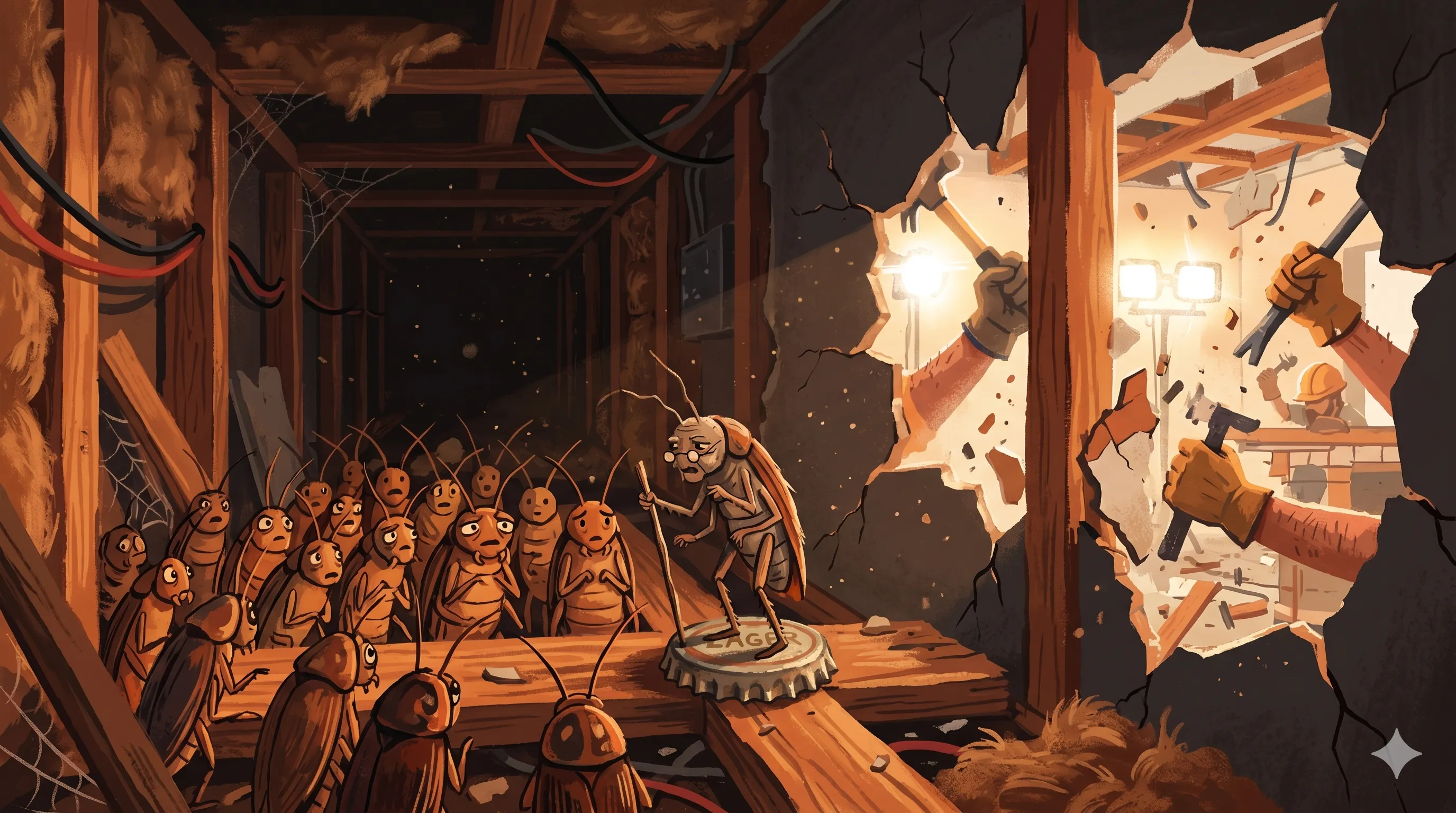
The Chronicles — Episode 1: The Great Kitchen Cleanse
When the humans above suddenly decide to renovate their kitchen, the cockroach community of Flat 4B must confront the biggest upheaval in living memory.
A work of fiction. Any resemblance to real kitchens, real cockroaches, or real renovation projects is — well — probably unavoidable.
Part One: The Trembling
It began, as most great catastrophes do, on a Tuesday.
Elder Cerci felt it first. A deep vibration in the skirting board — not the gentle rumble of the refrigerator, which the colony had long since catalogued as harmless, category three — but something new. Something purposeful.
“Drilling,” she announced to the morning assembly, her antennae pressed flat with authority. “Twelve millimetres from the south wall. Possibly fourteen.”
The assembly — forty-seven cockroaches arranged in loose concentric arcs around the grease stain they called the Grand Forum — stirred with concern.
“Could be seasonal,” offered young Skitter from the third row. He was new to assemblies, fresh from his second moult, and still inclined to optimism.
“Seasonal,” repeated Elder Cerci, in a tone that closed the matter.
Part Two: The Intelligence Reports
By Wednesday, Captain Antenn had assembled a reconnaissance team and dispatched them to the upper territories — a network of cracks behind the kickboard that offered sightlines into the kitchen proper.
The reports came back in fragments, as reports often do.
New tiles. White. Floor to ceiling.
The great wooden cabinet — dismantled.
A human in overalls, eating a cheese sandwich where the spice rack used to stand.
Captain Antenn received this intelligence at the base of the waste pipe and sat very still for a long time. He had survived the Great Bleach Campaign of three summers ago. He had weathered the Mysterious Disappearance of the Bin. He had personally navigated the colony through forty-eight hours of complete power failure, which had thrown off every light-avoidance calculation they possessed.
But renovation — renovation was different.
“They’re not attacking us,” he told the emergency council. “They’re not even thinking about us. That’s the problem.”
Part Three: The Debate
The council divided, as councils tend to.
The Traditionalists, led by Elder Cerci, argued for patience. “We have been here longer than their furniture. We will be here longer than their tiles. Wait.”
The Modernists, led by a fast-moving young cockroach named Dash who had spent considerable time near the router and considered herself broadly cosmopolitan, argued for immediate lateral expansion. “The bathroom behind the north wall has been under-colonised for two generations. Now is the moment.”
Skitter, still technically too junior to address the council, raised an antenna anyway.
“Has anyone asked what the new kitchen might offer?”
Silence.
“I mean — new tiles means new grouting. New grouting means new gaps. New gaps means new—”
“Sit down, Skitter,” said Elder Cerci and Captain Antenn together.
Part Four: The Cleanse
It arrived on Saturday morning without warning: a device the colony would later classify as The Instrument of Absolute Brightness, which the humans called a steam cleaner.
The evacuation was not orderly.
Forty-seven cockroaches relocated across four separate walls in eleven minutes, which remains, to this day, a colony record. Elder Cerci moved with a dignity that belied her speed. Captain Antenn personally ushered the three youngest nymphs through the emergency exit behind the boiler.
Skitter, who had lingered a fraction too long out of what he would later describe as scientific curiosity, was forced to take an unplanned detour through the airing cupboard, where he spent a disorienting two hours among the bath towels.
He was, he later admitted, not entirely miserable about this.
Part Five: The Aftermath
The new kitchen was — there was no honest way to avoid this — remarkable.
White tiles that ran unbroken to the ceiling. A new waste pipe with a slightly different routing that created, behind the panel beneath the sink, a cavity approximately four centimetres wider than the old one. A brand-new kickboard with a gap at the far left corner that had clearly been measured by someone who had never considered the possibility of colonisation.
It was, objectively, a significant upgrade.
“New grouting,” said Skitter, when the council reconvened a week later. He tried to keep the satisfaction out of his voice. He did not entirely succeed.
Elder Cerci examined the new terrain for a long time.
“The south wall access is better,” she finally admitted. “The ambient warmth from the new oven — superior to the old model, which ran hot on the left side and created unpredictable thermal zones.” She paused. “The tiles are cold, however. On the feet.”
“I’ve found a solution,” offered Dash. “There’s a small section near the dishwasher where the underfloor heating runs. I’ve drafted a territorial claim.”
The council reviewed the claim. The council approved the claim.
Skitter received, for the first time, a formal seat in the assembly.
Epilogue: What Was Learned
The Great Kitchen Cleanse passed into colony memory as a foundational event — not because it was the most dangerous thing the community of Flat 4B had ever faced, but because it was the thing that taught them the difference between a threat and a change.
Elder Cerci did not revise her general philosophy of caution. But she was observed, on more than one occasion, resting on the warm tiles near the dishwasher with what could only be described as contentment.
Captain Antenn updated the emergency protocols to include a section titled Renovation Events: Opportunities Within Disruption. He attributed the authorship to the council collectively.
Skitter eventually became the colony’s first formally appointed explorer — a position created specifically for him, with a remit that included the airing cupboard.
He visited regularly.
Next in The Chronicles — Episode 2: The Council of the Elders vs The Young Ones. When a new pesticide resistance emerges in the colony’s youngest generation, the question isn’t whether to adapt — it’s who gets to decide.
Related posts: How Cockroaches Survived 300+ Million Years · Types of Cockroaches in Indian Homes